
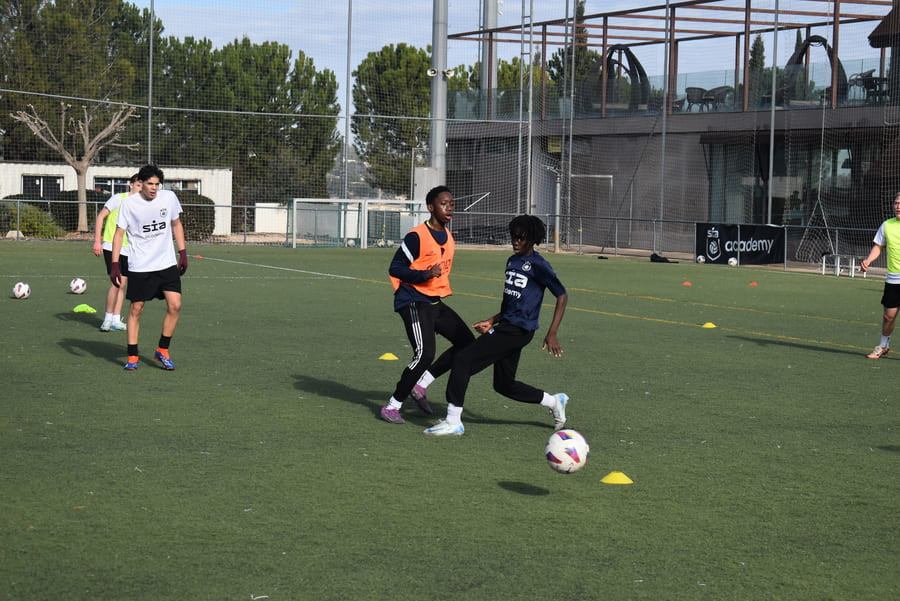
The seconds immediately after possession changes can decide whether a team creates an opening or allows the opponent to recover. Slow transition play gives defenders time to reorganize and leaves attackers isolated. Improving transition speed depends on recognition, movement, spacing, and quick decisions rather than simply running faster.
React Before the Opponent Resets
Players should recognize a change of possession immediately. After winning the ball, nearby teammates need to decide whether the situation favors a quick attack or controlled possession.
The first player receiving the ball should scan forward before automatically passing sideways. At the same time, attacking teammates need to move early enough to stretch defenders.
General team performance resources may introduce different approaches to coordinated play, but transition training should teach one basic habit: react immediately when possession changes.
Create Forward and Supporting Runs Together
A successful transition needs more than one runner sprinting toward goal. The player carrying the ball also requires passing support underneath and alongside the attack.
One runner can threaten space behind the defense while another moves into a central passing lane. A third may stay slightly deeper to protect against a turnover.
Looking at broader match-focused sports content can give players more context around competitive situations, yet coordinated movement still needs repetition on the training field.
| Transition Moment | Common Problem | Useful Reaction |
|---|---|---|
| Ball recovered | Everyone stays deep | Push support forward |
| Counter begins | One player attacks alone | Add multiple lanes |
| Forward lane closes | Pass is forced | Keep support underneath |
| Attack breaks down | Team stays stretched | Recover shape quickly |
Move the Ball Faster Than the Defense
Players sometimes confuse fast transition with dribbling at maximum speed. A well-timed pass often moves the attack forward faster than carrying the ball.
If a defender commits toward the ball carrier, an early pass can release a teammate into the space that defender abandoned. The next player should already know whether to continue forward or secure possession.
Players reading general football tactics material may encounter many transition concepts, but execution depends on timing. A good idea played two seconds late may no longer be a good idea.
Train Both Directions of Transition
Attacking transition receives plenty of attention because it can create exciting chances. Defensive transition matters just as much.
When possession is lost, the nearest players should pressure, delay, or protect dangerous passing lanes according to the team’s plan. Players farther away must recover into useful positions instead of watching the first challenge.
Training games can award points for scoring quickly after a turnover while also rewarding successful recovery. That forces players to think in both directions.
Where Fast Transition Becomes Reckless
Playing quickly after every turnover can create a different problem. Teams may repeatedly force forward passes when the opponent is already organized.
Speed should be connected to advantage. If three attackers face two defenders, moving quickly makes sense. If one attacker faces four defenders, keeping possession may be the smarter transition decision. Players should learn to recognize the difference. Fast football is not constant acceleration; it is reducing unnecessary delays when an opportunity is genuinely available.
Frequently Asked Questions
What is transition play in soccer?
Transition play describes the moments when a team changes from defending to attacking or attacking to defending after possession changes. These moments often require faster decisions than settled phases of play.
How do you improve attacking transitions?
Practice immediate forward scanning, coordinated runs, supporting angles, and quick passing after recovering possession. Drills should include realistic defenders so players learn when to attack quickly and when to keep the ball.
Why does my team counterattack too slowly?
Players may hesitate, fail to make early runs, receive without scanning, or carry the ball for too long. Poor spacing can also leave the first attacker without useful passing options.
Make the First Seconds Count
Strong transition play starts with awareness rather than speed alone. Players must recognize the change, move into useful spaces, and choose whether the moment calls for attack or control. Train those first decisions repeatedly, and the team will begin moving between defense and attack with far less hesitation.
Related Posts

Weak Exercise Focus — Track Progress With Clear Goals

NBA Trades Explained: How Smart Moves Shape Championship Teams